





PHP is a general-purpose programming language used to create dynamic websites. It is one of the most flexible and easy-to-use programming languages available, next to CSS and JavaScript. The language is readily accessible and secure, with a selection of frameworks to choose from and an entire community of developers to back it up.
This article will take a close look at the PHP programming language and why beginner programmers should study it.

What Is PHP Programming Language?
PHP is one of the primary programming languages developers use to create websites on the internet. As a server-side language, PHP runs scripts on the website’s server instead of the client’s web browser. PHP is also open-source, which means anyone who wants to use, modify, or distribute it can do so for free.
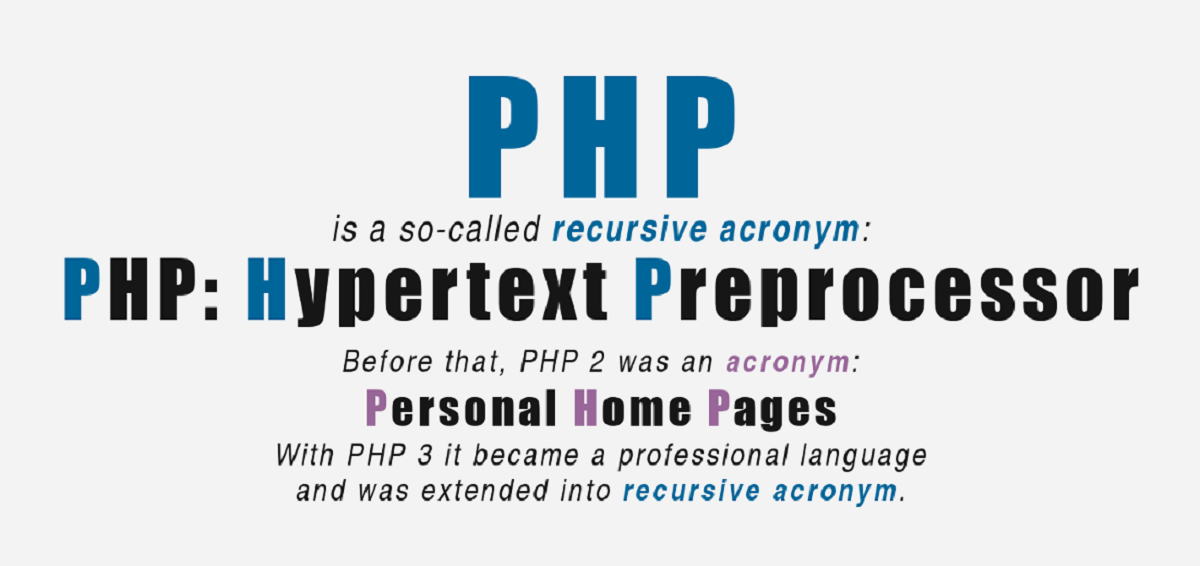
“PHP” stands for Hypertext Preprocessor. Initially, it was called “Personal Home Page” because it was used to create personal home pages. But the programming language evolved, acquiring new features and capabilities with each upgrade. Thus, the developers working on the language changed its name into something more appropriate to its function.
We also need to emphasize that PHP is mainly used for programming, not coding. As a programming language, it’s used to create executable machine programs instead of simply converting code from one language to another, as is the case with coding.
PHP can be used to create various web applications, starting from standard web pages to e-commerce platforms to GUI applications. In fact, reports indicate that over 80 percent of websites across the globe rely on PHP. Some websites that run on PHP programming include WordPress, Yahoo, Facebook, Flickr, MailChimp, and Wikipedia.
7 Reasons Why Beginner Programmers Should Study PHP Programming Language

JavaScript, Python, and C+ seem to be getting all the attention from online communities these days. But that doesn’t mean that the PHP programming language is already doomed to obscurity. It remains highly relevant and popular with a wide range of applications. So before you drop PHP off your list of things to learn, consider the following reasons why you should:
1. PHP Provides an Excellent Foundation for Programming

For beginner coders and those just diving into WordPress development, PHP is one of the best places you can start. There are only two things that you need to get started with PHP: a development environment to run your PHP scripts (e.g., XAMPP, WAMP) and a code editor to write the code (e.g., Notepad ++, Atom). Once you have your tools ready, you can already begin writing your PHP script. The task would be even faster and easier to accomplish with a framework.
But of course, we are working with the assumption that you have read or attended classes teaching you how to write PHP code. If you are just about to start your journey, there are a lot of resources (tutorials, e-books, PDFs, premium courses) that you can access online. Once you’re done with PHP, you can study other essential languages like HTML and CSS.
2. It Is Easy to Learn

PHP scripting is easy to learn, and its syntax is quite similar to Java, C, C++, and Perl. This means a person with experience in these languages should find it relatively easy to adapt to PHP. Like Java, PHP is an interpreted language; it’s ready to run and doesn’t require compilation into machine instructions. It provides the instructions for servers to interpret at runtime, making it less complicated than other programming languages.
Most experienced programmers also consider PHP as a stable programming language. A stable language is one whose fundamentals remain the same for a very long time. It allows programmers to use their knowledge and skills on that particular knowledge for a long time without the risk of everything becoming obsolete. On the other hand, you have an unstable language like JavaScript that receives a bombardment of updates and extensions, making it hard for programmers to keep up with.
But while PHP may be easier to learn than other languages, there’s still a learning curve that comes with it. Learning a programming language is never a walk in the park. Any experienced programmer can tell you it takes a lot of practice and experience to master any language, and PHP is no exception.
3. PHP Is Accessible to All

PHP is an open-source program, which means it’s available for download and use at zero cost. Not to mention, it’s also known for modification and distribution without special permission. Both beginners and experienced programmers can contribute to language development, and any developer can use the language to create web pages.
Another factor that plays into PHP’s accessibility has to do with the fact that it supports a large selection of mature frameworks. A framework is simply a program or code library that writes most of the code on your behalf and only leaves crucial decision points for you to code. Think of frameworks as customized versions of PHP. Developers create these frameworks for other developers, which means they are accessible for free. Examples of the most popular PHP frameworks include Laravel and Symfony.
4. Learning PHP Helps You Become a Well-Rounded Programmer

As a general-purpose programming language, PHP can be used to accomplish a wide range of tasks. Some examples you can achieve with PHP include: performing mathematical calculations, collecting user information, interacting with MySQL databases, creating graphics, etc. But more importantly, you can use PHP to create a wide selection of website types, including content management systems, GUI-based applications, information-based websites, and so on. You will also find it mentioned quite a lot in online forums and programming tutorials.
Developers who use PHP also rely on a standard called the PHP standard recommendation (PSR). PSR helps to ensure that they are operating on the same page, regardless of the type of project they are working on. It lists down the essential requirements and programming elements for using PHP. PSR consists of four different standards, including PSR-0, PSR-1, PSR-2, and PSR-4. PSR-1 and PSR-2 are basic programming standards, while PSR-0 and PSR-4 are programming standards for PHP’s autoloaders.
Another aspect of PHP is that you’re not restricted to the tools you can use. You can choose the type of text editor (e.g., Emacs, jEdit, Notebook++) and operating system. As a programmer, you want to be able to handle any project and enjoy as much flexibility to accomplish any task.
5. The Language Is Secure

PHP is a server-side language, processing the code left to the server instead of on the client’s web browser. Moreover, the servers are responsible for storing all the data associated with the website, And as you know, servers are protected with layers upon layers of security.
The original PHP developers designed it to work hand-in-hand with HTML, which is the standard format for all web pages on the internet. This works because an end-user or client sends a request to the server for a copy of an HTML page. The server then runs the PHP code first and sends the output in HTML format back to the requesting party. In other words, PHP is a precursor for generating the final HTML file that we see on websites.
The most crucial aspect of server-side scripting is that the client-side never sees the script, only the output of the script sent by the server. Moreover, you can also protect scripts on the server side with passwords. You can also configure your website to run all HTML files with PHP to protect the scripts from client browsers. The fact that your script runs on the server side offers more security for your website than the opposite.
The level of support for PHP is another factor that contributes to how secure the language is. Part of the job of the developers working on the program is to fortify it security-wise. For this reason, they include security patches in their regular updates. Having said this, you should always use the stable version of the program and install all updates to make sure that your program is up-to-date and secure.
6. There Is a Huge Community of Developers

PHP has been around for more than 25 years, and it has remained an open-source program throughout that time. During that time, it has managed to acquire a robust network of developers who work to enhance the capabilities of the language, essentially pushing its boundaries.
The way this works is developers have access to the source code. Their goal is to tweak the code to incorporate additional features and capabilities into the program. They also try to fix errors with the language. Developers typically aim for one minor update to be released per month and one major update to be released at least once a year, although, in reality, there’s no set schedule for these releases.
It’s important to note that the developers working to improve PHP aren’t paid to work on the program. But they do it anyway because they could use the extra features and capabilities. Practically anyone with some basic knowledge of programming can pitch in.
In addition, there is also a large repository of resources and information online about PHP. Should you need help regarding PHP, many blogs, forums, video tutorials, and e-books offer help with PHP programming.
7. PHP Is a Well-Established Programming Language

PHP is a legacy programming language, which means it’s been around for a long time now. A Danish-Canadian programmer named Rasmus Lerdorf created the original PHP code back in 1994. At the time, only one percent of websites on the internet had been built using PHP. Since then, developers have increasingly turned to PHP as their go-to language for web servers, and even now, we see it being used to back up popular websites. And keep in mind that you have a large selection of frameworks to choose from as well.
How Is PHP Programming Compared to Others?

Now that we have covered the features and benefits of the PHP programming language, it’s time to see how it fares in comparison to other programming languages (or frameworks):
PHP vs. JavaScript

PHP and JavaScript are both programming languages, specifically interpreted languages. An interpreted programming language is one that a program can interpret readily and without requiring compilation into machine instructions. However, these two are radically different in the way they operate. PHP operates on the server side, while JavaScript operates on the client side. The former runs its scripts through a server while the latter runs its script through a web browser.
Another consideration would be the fact that JavaScript and PHP have entirely different objectives. JavaScript is more concerned with the website’s visual elements, such as adding effects, layouts, and user interfaces. On the other hand, PHP is more focused on actual content on a web page. It completes tasks such as interacting with databases, retrieving information from servers, and evaluating data. In other words, PHP generates static HTML web pages while JavaScript transforms these web pages into something more interactive.
Another key difference has to do with the way they handle user input. Most developers use JavaScript to collect user information; specifically, they create online forms for people to fill out. PHP can’t collect input, but you can use it to process the input collected from JavaScript. Developers typically use PHP to connect databases to websites and JavaScript to input the data.
If you think about these differences, it becomes apparent that JavaScript and PHP complement each other. In truth, the very best websites use both PHP and JavaScript to create beautiful yet functional web pages. PHP is like a pen to paper, and JavaScript is the ink.
PHP vs. Python

PHP and Python are both general-purpose use languages that offer simplex syntax, making them ideal for beginner programmers.
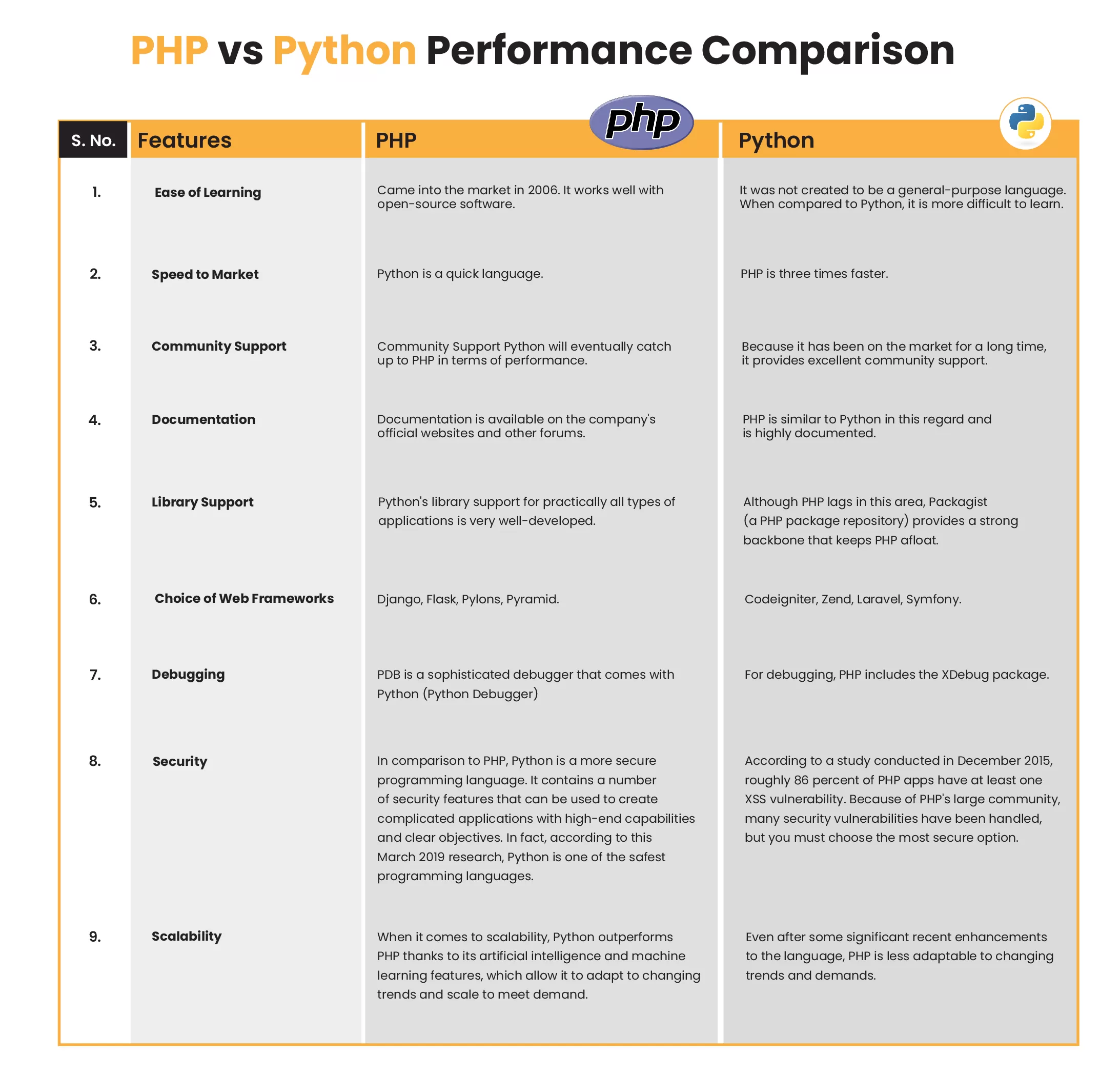
However, these two languages differ when it comes to their purpose. Python is a general-purpose programming language. This means you can use it to develop programs for the web and desktop and command line uses. At the opposite end is PHP, which focuses almost exclusively on creating web programs.
Both Python and PHP have frameworks to offer, but there are more options for PHP. PHP has been around for a lot longer than Python, which means there was much more time to develop frameworks. Many experienced developers also consider PHP a mature language, mainly because it has had years to expand in functionality and tools.
There are also noticeable differences in terms of speed and performance. The early versions of PHP were slow and took a lot of time to execute codes, which meant that Python had the upper hand. But PHP turned the tables with the release of PHP 7x, which offered faster loading times than Python. For websites that require ultra-fast loading speeds and high traffic volumes, PHP comes highly recommended.
However, Python seems to have the upper hand in scalability and adaptability. Its artificial intelligence and machine learning capabilities, coupled with its ability to scale up on demand, have allowed it to be helpful in a handful of industries. By contrast, PHP is less flexible regarding trends and growing demands, even after some great recent improvements.
Also read: Top 10 VR Programming Languages
PHP vs. Ruby on Rails
How does PHP fare in comparison to a framework like Ruby on Rails? Ruby on Rails (ROR) is a framework built on top of Ruby. Ruby is a general-purpose programming language for those who don’t know. Like PHP, Ruby on Rails also operates on the server-side, and it is also open-source.
But of course, the former is a framework while the latter is a programming language. As a framework, the objective of ROR is to simplify the programming process by automating common tasks while leaving legroom for crucial decisions. At the other end is PHP, which offers free reign over all problem-solving tasks.
Onto the metric of speed and performance, it doesn’t seem fair to compare the two because they work differently. Both of them are on the slow side, to begin with, and actual performance for PHP still depends on which framework you’re using. As for ROR, it sacrifices speed for functionality and ease of use. It also takes up more system resources than PHP.
But which one is easier to learn? As we’ve mentioned, PHP uses generic syntax and structure, allowing for a shallow learning curve. Many programmers choose to start learning PHP ahead of other languages if they don’t choose the good old C programming. In contrast, ROR is more complicated since you have to grasp an entire web of independent concepts.
When it comes to the level of support, PHP has the upper hand. If outsider information were to be trusted, PHP should have five times more dedicated resources than ROR. Not to mention, you are also more likely to find developers who specialize in PHP than ROR.
Final Thoughts

This concludes our list of the reasons why beginner programmers should study the PHP programming language. Without a doubt, some reasons exceed our list, but the aim of this guide is to cover the basics for beginners.
Conversely, any person could come up with a list of reasons not to study PHP. But those reasons only make sense to people who have no intention to code. There’s also no point in comparing your progress with others because these experiences are, for the most part, subjective.
But having said this, you need to consider the complexity of the problems you need to solve, as well as your level of experience as a programmer. But certainly, the single factor that matters is your own ability and willingness to learn.